COURSES FOR FREE, REGISTER NOW
Creative in research and teaching.
 |
 |


The Research Group Public Economic, Monetary Policy and Economic Crises organizes the II Workshop on Economic Crises, which will take place in Seville (Universidad de Sevilla - Facultad de Ciencias Económicas y Empresariales).
The workshop aims at exploring several topics related to economic crises such as their causes (economical or historical), effects (economical, political,
social…), the economic policies applied...
We invite researchers working on these or closely related topics to submit their manuscripts. We encourage submissions of empirical papers. An invited initial session will complement the contributed sessions.
The Keynote speaker will be:
Former member Executive Board of the European Central Bank
Professor IESE
Deadline for submissions:
e-mail: This email address is being protected from spambots. You need JavaScript enabled to view it.

We are pleased to inform all our members that, from now on, ASEPELT has a new institutional partner: the Cala Montero business group, to whom we extend our warmest welcome. We look forward to a long and fruitful collaboration together.
Creative in research and teaching.

The Journal of World Economy opens a call for papers for a special section on African economies at the crossroads: Challenges, strategies and policies, which will be published in issue number 76 (August 2027).
Guest Editors
Fernando Gallardo Olmedo (Universidad Autónoma de Madrid).
José María Mella (Universidad Autónoma de Madrid).
Elena Pérez Lagüela (Universidad Complutense de Madrid).
Structure of the Special Issue and contact:
Revista de Economía Mundial (REM) / Journal of World Economy (JWE) is an international academic journal edited by the Sociedad de Economía Mundial (World Economy Society) and indexed, among others, in SJR (Scopus), Social Sciences Citation Index, Fuente Académica Plus, International Bibliography of Social Sciences, ABI/INFORM, Business Source Premier, Public Affairs Index, and Business Source Elite.
REM / JWE opens a call for papers for a special issue on "African economies at the crossroads: Challenges, strategies and policies".
The special section will include up to 10–12 papers on the topic. If a larger number of high-quality papers are received, some of them may be published in the general section of subsequent issues of the REM / JWE.
Authors are strongly encouraged to carefully read the background and reasons included in this call for papers before considering the submission. You may see at the journal’s website more information on submission requirements at REM/JWE. You may also contact the editors at This email address is being protected from spambots. You need JavaScript enabled to view it..
Background and rationale of the Special Issue:
In a context of increasing climate pressures and an ever-increasing international competition, Africa’s development prospects are faced with a new set of challenges. Despite them, the continent’s economic, demographic, and geopolitical potential make it a key player in the 21st century. On the demographic dimension, Africa, with more than 1.5 billion inhabitants, is characterized by an extremely young population: around 60% are under 25 years old. This reality could represent both an opportunity and a constraint for the continent’s process of structural transformation. On the one hand, it offers a growing workforce capable of energizing the global economy; on the other, it poses serious problems of employment, education, and internal migration and displacement.
Africa is home to some of the poorest countries in the world, some of them are affected by significant social inequalities and limited access to basic services. Infrastructure development remains insufficient, and access to electricity is still very limited in many rural and urban areas. However, these shortcomings also represent a vast field of opportunity for foreign investment and international cooperation. To move forward in its development, the continent needs to attract sustained flows of external capital to boost job creation, productive diversification, and the modernization of strategic sectors.
Another pillar of Africa’s future lies in its enormous natural resource endowments: oil, gas, metals, minerals, fertile land, and a considerable potential for many kinds of renewable sources of energy, which include green hydrogen. The responsible management of these resources both by local authorities and transnational companies will be essential to ensure sustainable and inclusive growth. Furthermore, strengthening institutional development by improving political, judicial, and administrative systems is critical to guarantee stability, transparency, and social progress.
On the geopolitical stage, Africa holds an increasingly prominent position. Major powers—from the United States and the European Union to China, Russia, Turkey, the United Arab Emirates or India—are competing to establish strategic alliances, invest in infrastructure, and secure access to key resources. This competition will be beneficial only if it results in balanced cooperation, technological transfer, and respect for the sovereignty of African nations and their processes of regional integration. In this regard, international collaboration must be free from any neo-colonial practices, avoiding the perpetuation of dependent relationships and promoting genuine partnerships based on equality, mutual respect, and shared benefit.
Objectives and Scope:
The aim of this special edition is to provide a platform for authors, both from Africa and outside the continent, who approach the study of Africa’s economic reality from an innovative perspective, far removed from the excessively pessimistic or overly optimistic narratives that have been used in a less than rigorous manner to analyse the continent’s prospects for development and structural transformation.
We particularly welcome studies addressing: prospects for green industrial transformation and the development of regional value chains; debates on the renewed role of African states in promoting development policies in the context of the energy transition; the contribution of female employment to sustaining development through productive and reproductive work; economic integration under the AfCFTA; new perspectives of financing for development beyond the 2025 Seville Commitment; the role of non-traditional powers and new diplomatic, commercial and financial initiatives in Africa.
Possible topics (non-exhaustive list):
Submissions:
Papers can be written in English or Spanish, although REM/JWE recommends English since it can reach a greater audience. The full papers received will be subject to previous editorial scrutiny, pre-selection, and a strict peer-review process before acceptance. Therefore, an exhaustive knowledge of the specific published literature will be appreciated. Articles should be no more than 8,000 words, inclusive of references, notes, and tables. Articles must include an abstract of 100 words and up to five keywords. Submissions should be sent directly through the REM/JWE on-line handling platform:
http://uhu.es/publicaciones/ojs/index.php/REM/about/submissions#onlineSubmissions
Timeline:
The deadline for the submission of full papers is November 15th 2026. The papers will be published in the special section of the second issue of 2027 (nº 76, August 2027).
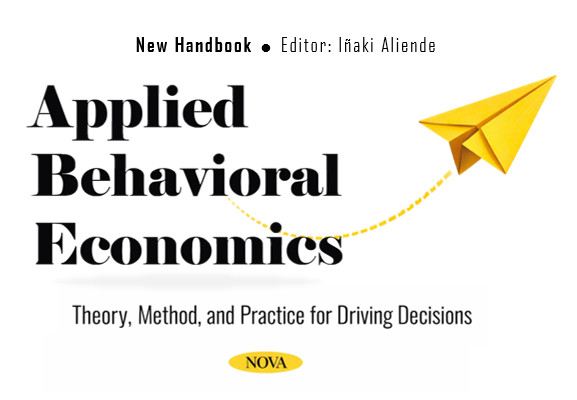
The manual Applied Behavioral Economics: Theory, Method, and Practice for Driving Decisions has just been published. This is a collective project in which I have had the good fortune to participate as an Editor alongside colleagues from academia and the business world, including Loren Escot.
The book rigorously integrates behavioral approaches into economic analysis and real-world decision-making, both in academic and organizational contexts.
The manual is designed as a useful tool for:
* Integrating behavioral approaches into economic analysis and decision-making.
* Connecting empirical evidence with real public policy problems.
* Designing decision-making contexts within organizations, markets, and institutions.
Links are provided both to the sales page and to a free sample of the introductory chapter.
Best regards,
Iñaki