COURSES FOR FREE, REGISTER NOW
Creative in research and teaching.
 |
 |


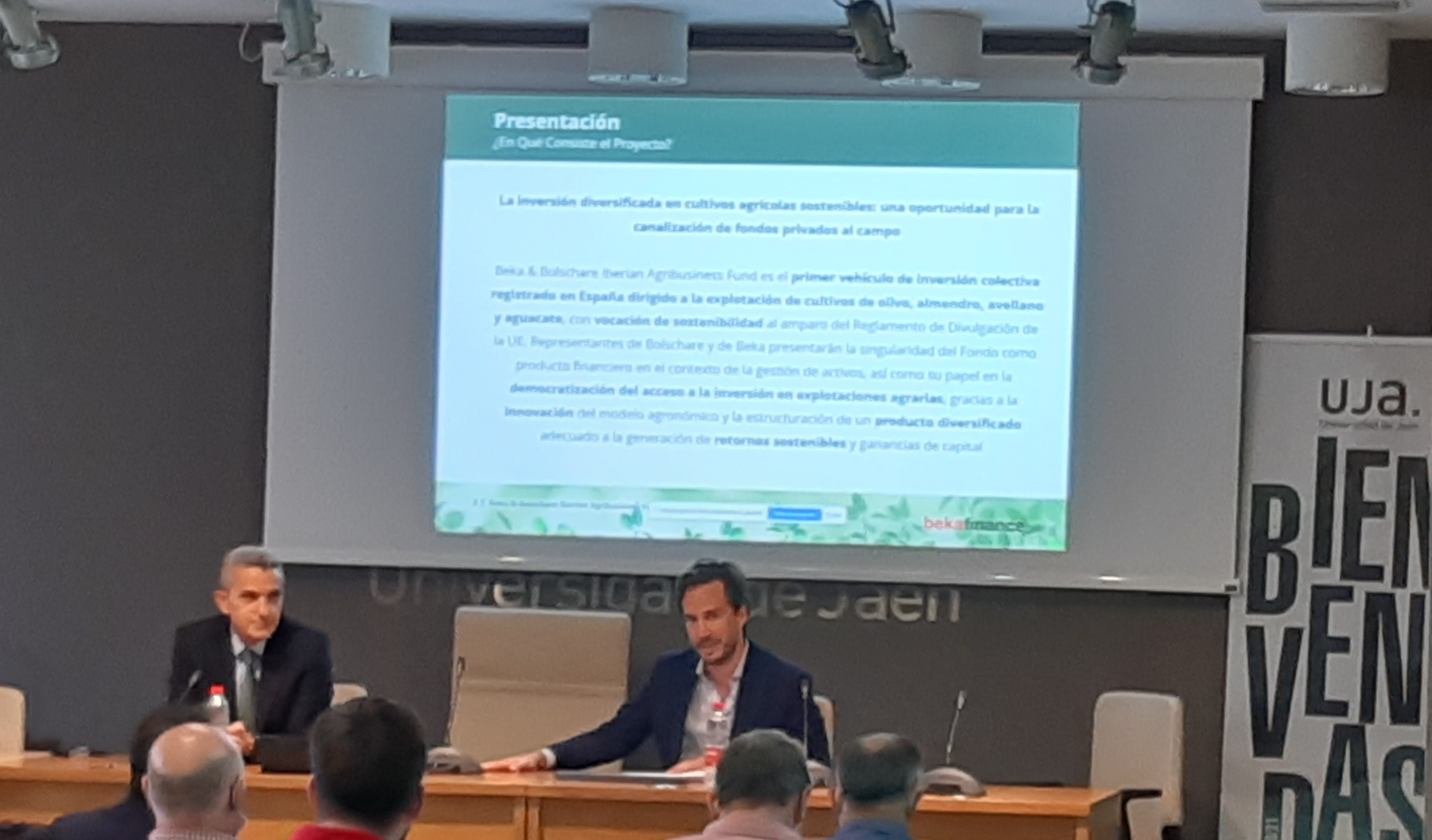
On October 6, the XXXIV ASEPELT Congress began with the seminar Diversified investment in sustainable agricultural crops: an opportunity to channel private funds to the countryside, by Borja Menéndez (Asset Manager Beka Asset Management) and Dimas Antúnez Moreno (CFO Bolschare) .
Beka & Bolschare Iberian Agribusiness Fund is the first collective investment vehicle registered in Spain for the exploitation of olive, almond, hazelnut and avocado crops, with a vocation for sustainability under the EU Disclosure Regulation. Representatives of Bolschare and Beka presented the uniqueness of the Fund as a financial product in the context of asset management, as well as its role in democratizing access to investment in agricultural holdings, thanks to the innovation of the agronomic model and the structuring of a diversified structure product suitable for generating sustainable profitability and capital gains.
The video of the workshop is available to our partners trough this link:
https://drive.google.com/file/d/1x1FcPSs1v6AMbqET2VZbV-ULhz7UuxR_

The three finalists of the ASEPELT / Exponential Education 2021 International Award to the Best Scientific Undergraduate Paper are already known.
From among the twenty papers presented, all of them of exceptional quality, the Evaluation Committee has selected the following:
The award will be announced and delivered at the gala dinner of the XXXIV Conference of Applied Economics-ASEPELT, Jaén 2020. Complete information about the event can be seen in the rules of the competition.
Creative in research and teaching.
We already know the three finalists for the ASEPELT CCRJ - TFM award for the Best Article from the Master's Final Project!
After a long deliberation, given the high quality of the works presented, the jury in charge of awarding the prize has decided that the three finalists are:
The three finalist works will have free registration in the congress, accommodation and meals on the day of the presentation and presentation of the award, as well as a commemorative plaque. In addition, the winner, who will be announced after the defense session of the three selected works, will receive the following prizes: